
An AI pipeline with Go, NATS and Dagster
A Go gateway with OpenAI/Anthropic-compatible APIs, NATS JetStream and Dagster sensors connects LLMs to business pipelines. The design covers RAG, events and three hosts for AI application development.

Implemented platform
I built an OpenAI/Anthropic-compatible API gateway in Go to connect LLMs to business pipelines. It handles RAG requests and publishes events to NATS JetStream using fire-and-forget. Dagster daemon sensors pull events and execute jobs. Vector (Rust) subscribes to NATS and sends telemetry to Prometheus/Loki.
The gateway publishes events; each middleware consumes them independently. This removes the gateway’s Dagster dependency and allows separate deployments.
The initial Rust (axum) prototype was migrated to Go. Goroutines and channels reduced the code needed for concurrent SSE relay, NATS subscription and PG/pgvector writes.
Components
- Language: Go 1.25, Gin framework
- Messaging: NATS 2.11 (JetStream enabled)
- Orchestration: Dagster (Python) — daemon + sensor + asset materialization
- Data store: PostgreSQL 18 + pgvector (JIT enabled)
- Telemetry: Vector 0.45 (Rust) → Prometheus + Loki + Grafana
- Inference backends: vLLM, llama.cpp, LM Studio
- Embedding + Reranker: multi-bert-inference — Rust (Axum) + ONNX Runtime (INT8, ~17MB, ~10ms). ColBERT 256d embed + 64d token MaxSim rerank. DB-free, gRPC 256d vec direct transmission (~1KB/candidate)
- Containers: Podman rootless + podman-compose
- Host topology: 3 hosts (storage server / desktop mac / compute server)
Design Decisions
Layered Architecture
The implementation separates Transport, Domain and Infrastructure, using Clean Architecture dependency rules.
  Client (opencode CLI, API consumer)
    |
    v
Transport Layer (Gin) [internal/transport/http/]
    |-- middleware: RequestContext -> Logger -> Recovery
    |-- v1/ handlers (OpenAI/Anthropic compatible endpoints)
    |-- Request parsing and validation
    +-- Presentation DTO conversion
    |
    |  Presentation Layer [pkg/openai/, pkg/anthropic/]
    |    +-- OpenAI/Anthropic compatible request/response DTOs
    |
    v
Domain Layer [internal/domain/]
    |-- knowledge/  RAG orchestration
    |-- llm/        Multi-backend LLM routing
    |-- vectorstore/ Vector search (pgvector ANN)
    +-- pipeline/   Pipeline integration (NATS publish, fire-and-forget)
    |
    v
Infrastructure Layer [internal/infra/]
    |-- vllm/       vLLM client
    |-- llamacpp/   llama.cpp client
    |-- lmstudio/   LM Studio client
    |-- postgres/   PostgreSQL + pgvector
    |-- nats/       NATS JetStream publish
    |-- vector/     Vector telemetry publish
    +-- reranker/   multi-bert-inference gRPC client
The Domain layer has no external dependencies. Changes to LLM backends or data stores stay in Infrastructure. This also separates business logic from integrations in business application development.
Gateway Is Publish-Only
The gateway only publishes to NATS. No subscribing, no triggering. Consumers (Dagster sensor, Vector) independently pull/subscribe.
The intended effects are:
- Separate deployments without a Dagster dependency in gateway code.
- Add or change consumers without changing the gateway.
- Isolate gateway and pipeline failures.
Dagster’s role
Dagster daemon acts as a durable consumer, pulling from JetStream. Sensor → RunRequest → direct job execution. The GraphQL trigger bridge was eliminated in favor of Dagster’s native sensor mechanism.
Why Dagster (Python)
Dagster manages execution order and state. Heavy computation runs outside Python.
| Actual Computation | Execution Engine | Python/Dagster Role |
|---|---|---|
| LLM inference | vLLM / llama.cpp (C++/CUDA) | API call only |
| Vector search | PostgreSQL + pgvector (C) | SQL query only |
| Embedding + Reranking | multi-bert-inference (Rust/ONNX Runtime) | gRPC call only |
| Telemetry conversion | Vector (Rust) | YAML config only |
I chose Dagster for lineage tracking, sensors and asset materialization. I had not found a Rust replacement. For this I/O-wait and state-management workload, those features mattered more than Rust’s CPU-bound performance and memory-safety benefits.
LLM Backend Selection
Backend is automatically selected based on the requested model name.
| Backend | Default URL | Example Models |
|---|---|---|
| vLLM | http://$COMPUTE_HOST:8000 | qwen3-next:80b, qwen3-coder:30b |
| llama.cpp | http://$COMPUTE_HOST:8081 | nemotron-3-nano:30b |
| LM Studio | http://$COMPUTE_HOST:1234 | lfm2.5-1.2b-instruct-mlx |
Gateway goroutines handle LLM routing. Choosing a backend based on response content requires stateful control, so Vector does not perform that role.
I continue to evaluate model performance and quality. Verified models are archived in GGUF, NVFP4, ONNX and other formats on storage-server cold storage.

Rust to Go Migration
The initial Rust (axum) prototype used its type system to define the design, but required more code for concurrent asynchronous operations.
- Managing async contexts for SSE relay + NATS subscription + PG/pgvector writes simultaneously was verbose in Rust
- goroutine + channel naturally fits this pattern
- Runtime overhead difference is negligible for this use case
All design principles were preserved after migration: OpenAI-compatible endpoints, NATS Pub/Sub event-driven architecture, trace_id on all logs, idempotent design. The Rust design documents served as specifications for the Go implementation.
Implementation
Endpoints
| Method | Path | Description |
|---|---|---|
| POST | /v1/chat/completions | Chat completions (OpenAI compatible) |
| POST | /v1/messages | Anthropic Messages API |
| POST | /v1/responses | Responses API |
| POST | /v1/embeddings | Embeddings |
| GET | /v1/models | Model listing |
| GET | /healthz | Health check |
Middleware Chain
Gin middleware: RequestContext → Logger → Recovery
- RequestContext — Extracts request tracking ID from
X-Correlation-IDorX-Request-IDheader. Auto-generates a timestamp-based ID when absent, setting it on both context and response header - Logger — Records method, path, status, duration per HTTP request via
slog - Recovery — Gin standard panic recovery
RAG Data Flow
  Client
  |
  v
Chat Completion Request
  |
  v
Knowledge Service (RAG orchestration)
  |-- 1. User query extraction
  |-- 2. Embedding generation (multi-bert-inference -> 256d ColBERT)
  |-- 3. Vector search (pgvector HNSW ANN) + reranking (ColBERT MaxSim)
  |-- 4. Context injection
  |-- 5. Send to LLM backend
  |-- 6. NATS publish (pipeline.* + telemetry.*)  <- fire-and-forget
  +-- 7. Response to client
System Topology
                                 NATS JetStream :4222
                              +----------------------+
                              |  pipeline.*           |
                              |  telemetry.*          |
                              +---+----------+--------+
                    publish ------+          | pull subscribe
                    (fire & forget)         | (durable consumer)
                                           |
+-- agent-gateway :8080 ------+    +-- Dagster daemon -----------------------+
|                             |    |                                         |
|  Client Request             |    |  sensor: nats_dagster_chat_persist      |
|    |                        |    |  sensor: nats_dagster_embedding         |
|    v                        |    |  sensor: nats_dagster_retrieve          |
|  Knowledge Service          |    |  sensor: nats_dagster_compose           |
|    |-- embed (multi-bert)   |    |  sensor: nats_dagster_flow_lineage     |
|    |-- vector search (pg)   |    |  sensor: nats_dagster_tool_call        |
|    |-- rerank (ColBERT)     |    |         |                               |
|    |-- LLM inference -------|-->-|  vLLM / llama.cpp / LM Studio          |
|    |                        |    |         |                               |
|    |-- NATS pub: pipeline.* |    |         v                               |
|    |-- NATS pub: telemetry.*|    |  RunRequest -> Dagster job execution   |
|    +-- Response             |    |    |-- chat persist -> pg               |
|                             |    |    |-- embedding event -> pg            |
|  LLM Backends               |    |    |-- retrieve event -> pg             |
|    |-- vLLM :8000           |    |    |-- compose event -> pg              |
|    |-- llama.cpp :8081      |    |    |-- flow lineage -> pg               |
|    +-- LM Studio :1234     |    |    +-- tool call -> pg                  |
|                             |    |                                         |
+-----------------------------+    +-----------------------------------------+
                                           |
                              +------------+
                              | pull subscribe
                              v
                    +-- Vector (Rust) ----------------------+
                    |  source: nats (telemetry.*)           |
                    |    |-- sink: Prometheus exporter      |
                    |    +-- sink: Loki (CorrelationID)    |
                    +--------------------------------------+
NATS Event Design
Two independent paths share the same CorrelationID.
Pipeline (Dagster sensor → job execution):
| Topic | Dagster Job |
|---|---|
pipeline.knowledge.chat.persist | knowledge_chat_persist + knowledge_chat_pair_materialize |
pipeline.knowledge.embedding | knowledge_embedding |
pipeline.knowledge.retrieve | knowledge_retrieve |
pipeline.knowledge.compose | knowledge_compose |
pipeline.knowledge.flow.lineage | knowledge_flow_lineage |
pipeline.knowledge.tool_call | knowledge_tool_call |
Telemetry (Vector → Prometheus / Loki):
| Topic | Content |
|---|---|
telemetry.knowledge.chat | Model, backend, token usage, streaming flag |
telemetry.knowledge.embedding | Model, input count, dimensions |
telemetry.knowledge.retrieve | TopK, hit count, scores |
telemetry.knowledge.tool_call | Function name, model |
JetStream stream configuration:
PIPELINE— subjects:pipeline.>, retention: limits, max-age: 72h, storage: fileTELEMETRY— subjects:telemetry.>, retention: limits, max-age: 24h, storage: file
Dagster Assets and Jobs
The Dagster side is structured with asset materialization + sensor patterns.
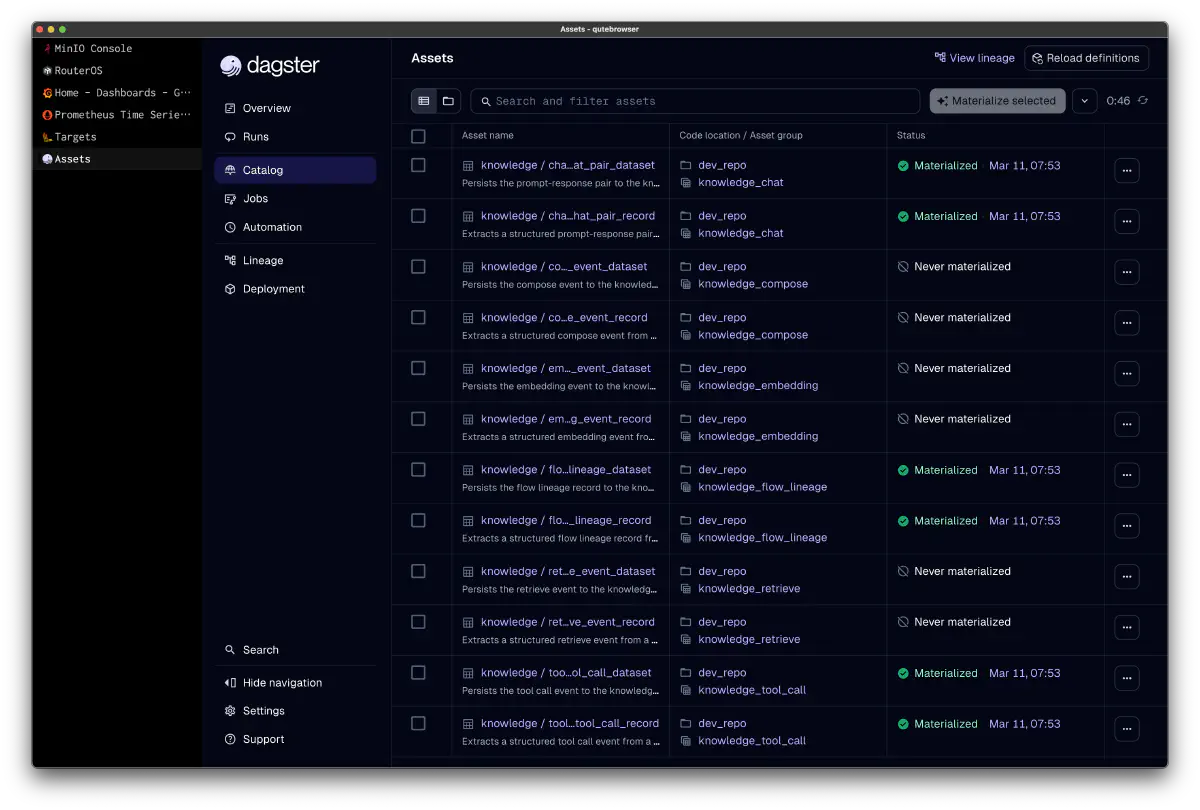
Each sensor pull-subscribes from NATS JetStream, detects events, and issues RunRequests for direct job execution. No GraphQL API involved.
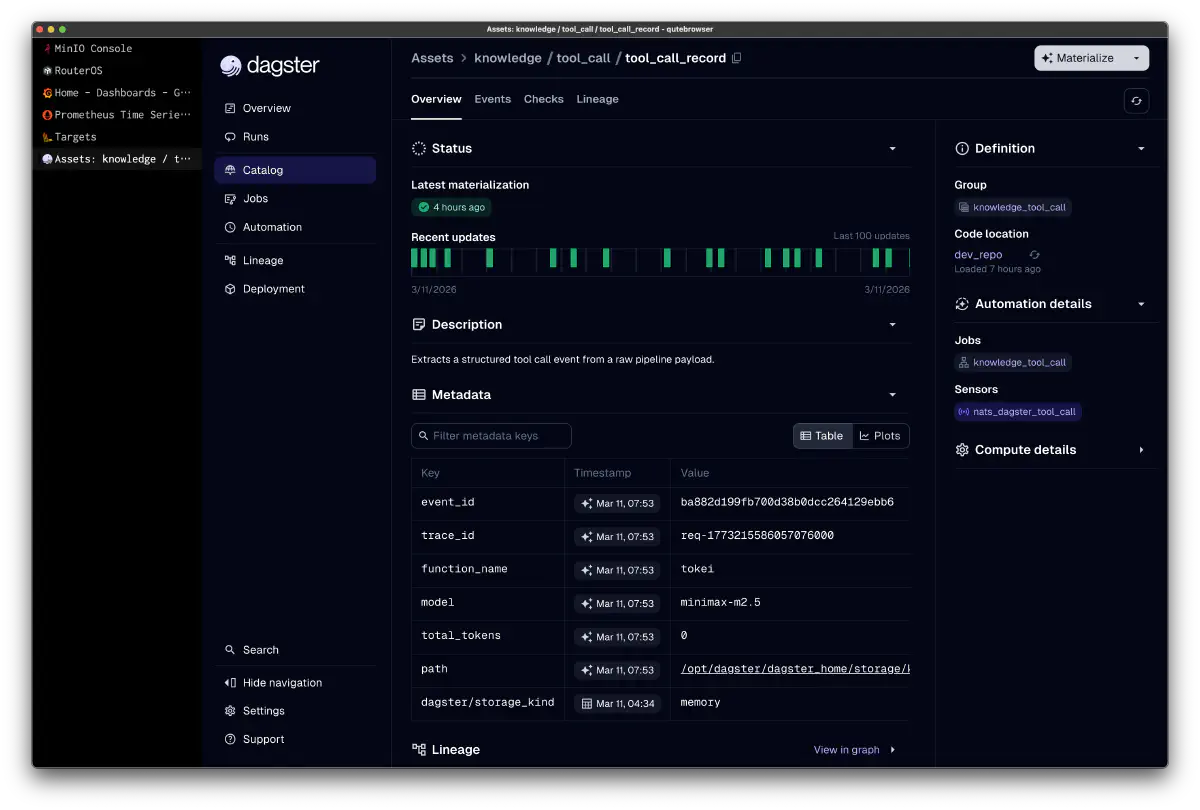
Example tool_call_record: function_name: tokei, model: minimax-m2.5 — records which tool was called by which model as an event, enabling lineage tracking in Dagster.
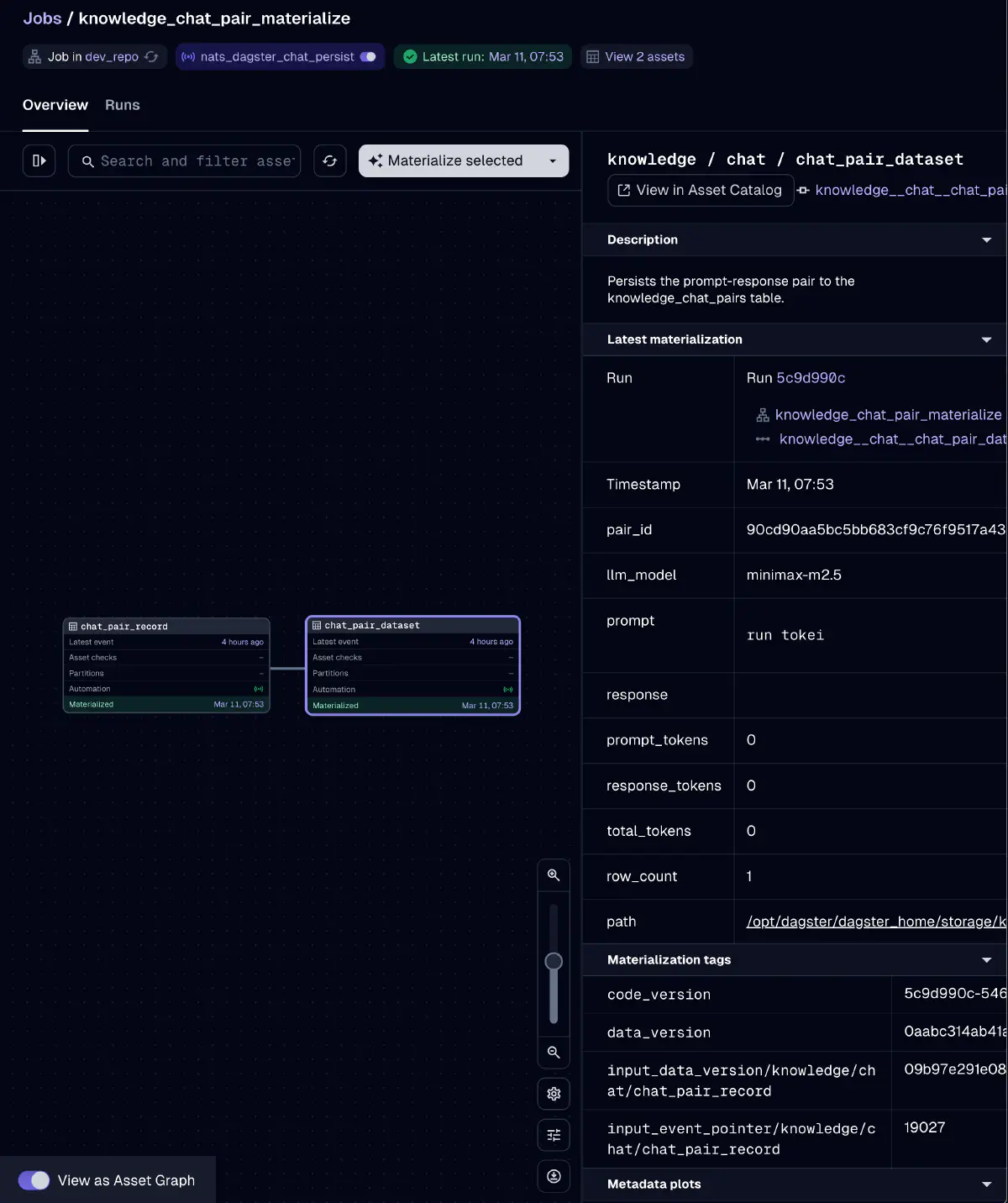
The knowledge_chat_pair_materialize job materializes two assets: chat_pair_record and chat_pair_dataset. It persists prompt-response pairs to PostgreSQL as raw material for future fine-tuning dataset construction.
devstack Container Layout
All middleware runs as rootless containers via podman-compose.
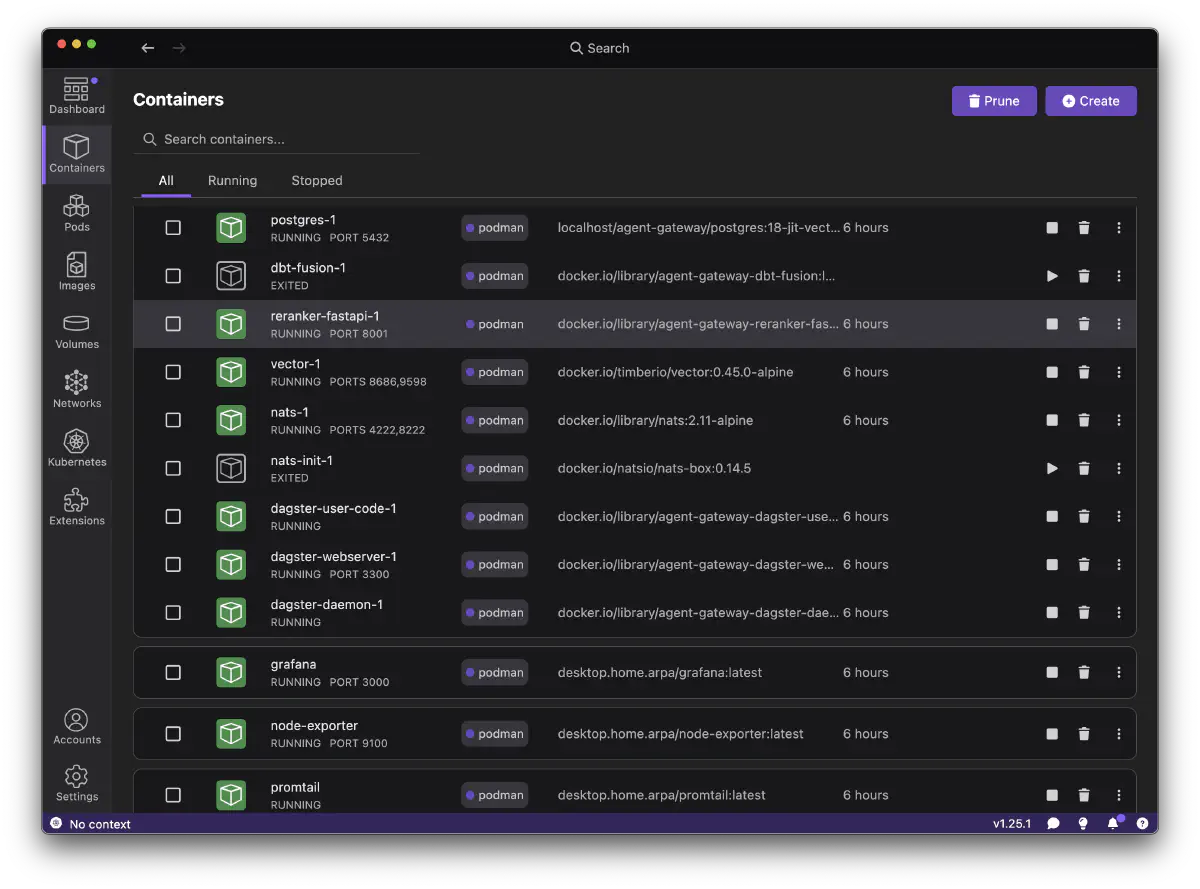
| Service | Image | Ports | Role |
|---|---|---|---|
| NATS | nats:2.11-alpine | 4222, 8222 | JetStream messaging |
| PostgreSQL | postgres:18-jit-vector | 5432 | pgvector + JIT, agent_gateway / dagster DB |
| Dagster | Custom build | 3000 | Webserver + Daemon + User-code gRPC |
| Vector | timberio/vector:0.45.0-alpine | 8686, 9598 | NATS telemetry → Prometheus/Loki |
| multi-bert-inference | Rust (Axum) + ONNX Runtime | 3001 (HTTP), gRPC | ColBERT embed (256d) + rerank (64d MaxSim) |
Lakehouse profile (for Phase 2, explicit startup):
- Nessie (19120) — Iceberg metadata catalog (git-like branching)
- Trino (8081) — SQL engine with Iceberg catalog
- dbt-fusion — dbt CLI container
3-Host Network Topology
NATS co-located with the gateway, keeping all paths within 1 hop.
  +-- storage server (observability) --+  +-- desktop mac (gateway) ----------+  +-- compute server (inference) ------+
|                                    |  |                                   |  |                                     |
|  Prometheus <-- scrape --------------|-- :9598 (Vector exporter)          |  |  vLLM :8000 (GPU inference)         |
|  Grafana                           |  |                                   |  |  llama.cpp :8081                    |
|  Loki <-- push -----------------------  Vector (nats source)             |  |                                     |
|  Vector (aggregator)               |  |       |                          |  |  Dagster :3000                       |
|    |-- nats source --------------------  NATS JetStream :4222 <---------|--|---- daemon sensor (pull subscribe)  |
|    |-- -> Loki sink                |  |       ^ publish                  |  |    |-- webserver                     |
|    +-- -> Prometheus exporter      |  |       | (fire-and-forget)        |  |    |-- daemon (sensor -> job)        |
|  MinIO :9000                       |  |       |                          |  |    +-- user-code gRPC               |
|                                    |  |  agent-gateway :8080             |  |                                     |
|                                    |  |    |-- proxy API                 |  |  PostgreSQL 18 :5432                |
|                                    |  |    |   (OpenAI/Anthropic/        |  |    +-- pgvector (ANN + full-text)   |
|                                    |  |    |    Responses)               |  |                                     |
|                                    |  |    |-- knowledge orchestrator    |  |  multi-bert-inference :3001         |
|                                    |  |    +-- NATS pub ----------------|--->  pipeline.* + telemetry.*          |
|                                    |  |                                   |  |                                     |
|                                    |  |  LM Studio :1234 (CPU inference) |  |  Trino :8080                        |
|                                    |  |                                   |  |  Nessie :19120                       |
+------------------------------------+  +-----------------------------------+  +-------------------------------------+
| Host | Role | Key Services | Uptime |
|---|---|---|---|
| storage server | Observability + object storage | Prometheus, Grafana, Loki, Vector, MinIO | 24/7 |
| desktop mac | Gateway + messaging | agent-gateway, NATS JetStream, LM Studio | Working hours |
| compute server | GPU inference + data platform | vLLM, llama.cpp, Dagster, PostgreSQL, Trino | Working hours |
NATS shares desktop mac with the gateway, the largest publisher, avoiding a host-to-host publish hop. Desktop and compute start and stop together. Storage runs continuously, and Vector reconnects after a disconnection.
Data Storage Strategy
Storage is split by data characteristics between PostgreSQL (pgvector) and Iceberg (Parquet).
                      PostgreSQL (pgvector)             Iceberg (Parquet via Trino/Nessie)
                    --------------------             -----------------------------------
Characteristics     Structured + vector search        File-oriented + bulk accumulation
Queries             WHERE + ANN (nearest neighbor)    SQL JOIN + time-travel
Update pattern      UPSERT (row-level)                append-only (immutable Parquet)
Versioning          None (self-managed history)       Nessie branches + Iceberg snapshots
In Phase 1 (real-time), all data is written directly to PostgreSQL. From Phase 2 onward, Dagster batch processes will convert PG data to Parquet → Iceberg append, with dbt-fusion building analytical datasets.
PostgreSQL Schema
- document_chunks — 256-dimension ColBERT embeddings + HNSW vector index
- chat_history — Conversation history by correlation_id
- rerank_scores — Reranking scores per query x document x model
- api_responses — Responses API persistence
Caveats
- When desktop mac / compute server are stopped, NATS goes down too, but JetStream persistent data is retained on desktop mac disk and resumes from unconsumed messages on next startup
- Vector detects disconnection and auto-reconnects, but telemetry events during NATS downtime are lost (pipeline side is protected by JetStream durable consumers)
- PostgreSQL 18 JIT requires
shm_size: 4gbconfiguration. Insufficient allocation risks OOM kills
Verification
- Confirmed asset materialization status in Dagster UI: chat_pair, flow_lineage, tool_call successfully Materialized
- Monitored stream state and consumer lag via NATS monitoring (
:8222) - Verified telemetry metrics delivery through Vector exporter (
:9598) → Prometheus - Integration tests:
go test -tags=integration ./internal/infra/integration ./internal/domain/pipeline
Next Actions
Phase 1, the real-time platform, was operational at the time of writing. The following phases remain planned.
| Phase | Content | Status |
|---|---|---|
| 1 | gateway → NATS → Dagster/pg, Vector → Prometheus/Loki | Running |
| 2 | pg → Parquet → Iceberg batch, dbt-fusion processing | devstack ready |
| 3 | MCP server tool definitions, Trino query tool, hypothesis testing automation | Not started |
| 4 | Fine-tuning pipeline, MOE expert pruning, synthetic data augmentation | Not started |