
Generating a Django booking site with Qwen3.5
A local web application development test with Qwen3.5-122B-A10B and MCP. It covers booking, admin, expansion to six apps, and manual fixes needed when using LLMs for business systems.

Generating a Django booking site locally
I used Q5_K_M Qwen3.5-122B-A10B to generate a Django 5 travel booking site without cloud APIs. An MCP agent handled files; I applied manual fixes and two feature-expansion requests. The test examines local LLM use for web and business application development.
The question was whether a quantized local MoE model could generate aligned models, views, templates, and admin configuration.
Local Inference Environment
| Item | Details |
|---|---|
| Model | Qwen3.5-122B-A10B (MoE, 10B active / 122B total parameters) |
| Quantization | Q5_K_M (GGUF, 3-shard split) |
| Inference Engine | ik_llama.cpp (OpenAI-compatible API server) |
| MCP Tools (custom) | ctree (code symbol analysis), pathfinder (path resolution) |
| MCP Tools (OSS) | serena (semantic code operations), filesystem (file read/write), ripgrep (search) |
| Context Usage | ~77K prompt tokens |
All inference ran locally, without external APIs or token billing. The agent used serena for symbols, filesystem for I/O, ripgrep for search, ctree for structure, and pathfinder for paths.
Motivation
Why Test Locally Instead of Using Cloud APIs
Using cloud models such as Claude Sonnet or GPT-4o involves:
- Token costs over repeated development
- Sending code to external servers
- API availability and rate limits
I tested a 122B MoE model in Q5_K_M on ik_llama.cpp as a coding agent. This does not establish cloud-equivalent quality.
One-Shot Generation Approach
I provided the complete specification to generate all files together, aiming to align models, views, templates, forms, seed data, and admin fields.
Specification Design
Technology Stack
| Component | Choice | Rationale |
|---|---|---|
| Backend | Django 5.x | Python 3.13 compatible, full ORM, auto-generated admin |
| Frontend JS | Alpine.js v3 (CDN) | Works within Django templates, no build step |
| CSS | Tailwind CSS | Material Design 3 inspired utility-first approach |
| Package Manager | uv | Fast Python package manager |
| Database | SQLite | Development only, zero configuration |
Initial Domain Models
The initial three models were:
  TravelPackage  1 ──── N  Tour
Tour           1 ──── N  Reservation
TravelPackage (travel product):
- Title, slug, region, duration, image URL
is_publishedflag for visibility controlmin_priceproperty for dynamic lowest tour price retrieval
Tour (scheduled departure):
- Specific departure/return dates, price, remaining seats
- Status management (available / soldout / cancelled)
is_reservableproperty for reservation eligibility
Reservation (booking):
- Customer information (name, email, phone, guests, notes)
- FK relationship to Tour
- No payment processing (DB persistence only)
Business Rules
Publication and reservation rules:
- Only packages with
is_published=Trueappear on the frontend - Only tours with
status="available"can be reserved - Price display shows the lowest tour price within a package (
Minaggregation) - Reservation flow follows a 3-step pattern: form → confirmation preview → completion
- Database write occurs only on the confirmation POST (via session storage)
UI Wireframes
ASCII wireframes and explicit Tailwind classes defined the layout.
  ┌─────────────────────────────────────────────────┐
│  HERO SECTION: bg-gradient-to-r from-blue-600   │
│  [SVG airplane animation flying across]         │
│  "Discover Your Next Adventure"                 │
│  [ Browse All Packages → ]                      │
├─────────────────────────────────────────────────┤
│  FEATURED PACKAGES (card grid)                  │
│  ┌──────┐  ┌──────┐  ┌──────┐                  │
│  │Card 1│  │Card 2│  │Card 3│                   │
│  └──────┘  └──────┘  └──────┘                  │
└─────────────────────────────────────────────────┘
Material Design 3 Specifications
| Role | Tailwind Class | Usage |
|---|---|---|
| Primary | bg-blue-600 | Buttons, links, active states |
| Surface | bg-white | Cards, modals, form backgrounds |
| Elevation Level 2 | shadow-md | Main cards, header |
| Border Radius | rounded-2xl | Cards; rounded-xl for buttons |
Hover effects: hover:shadow-lg hover:-translate-y-1 transition-all duration-200
Code Generated by Local LLM
Alpine.js Filtering
The generated Alpine.js client-side filter:
  x-data="{
    region: '',
    maxPrice: ''
}"
  x-show="(region === '' || $el.dataset.region === region) &&
        (maxPrice === '' || parseInt($el.dataset.minPrice) <= parseInt(maxPrice))"
It works without a server-side API.
Session-Based Reservation Flow
The generated three-step reservation flow:
- Form input (
/reserve/<tour_id>/): After validation, data is saved to session - Confirmation preview (
/reserve/<tour_id>/confirm/): Read from session, display summary - Completion (
/reserve/success/): Confirmation POST saves to DB, clears session
  # ReservationCreateView: POST saves to session
request.session['reservation_data'] = form.cleaned_data
return redirect('reservation_confirm', tour_id=tour.id)

# ReservationConfirmView: POST saves to DB
data = request.session.pop('reservation_data')
Reservation.objects.create(tour=tour, **data)
return redirect('reservation_success')
Django Admin Configuration
Admin configuration includes inline editing aligned with the models.
  class TourInline(admin.TabularInline):
    model = Tour
    extra = 1

@admin.register(TravelPackage)
class TravelPackageAdmin(admin.ModelAdmin):
    list_display = ["title", "region", "duration_days", "is_published"]
    list_editable = ["is_published"]
    prepopulated_fields = {"slug": ("title",)}
    inlines = [TourInline]
Seed Data
seed_demo generates five packages and 14 tours for regional filter checks.
Agent-Driven Incremental Expansion
After fixing the initial output, I requested two expansions. The agent read existing code and added models and apps, with manual corrections at each stage.
| Added App | Key Models | Agent’s Work |
|---|---|---|
shop | Shop (store locations) | Added Shop model to models.py, registered admin, created templates |
reviews | Review, Rating, ReviewPhoto | Full review system with approval workflow |
search | SearchIndex, TrendingKeyword | Search index and trending keyword management |
accounts | User, UserProfile, UserActivity | User authentication and profile management |
It checked FK relations in tours/models.py. I fixed quote escaping, missing imports, and cross-template inconsistencies. The work felt roughly 80% generated and 20% manual correction.
Generation Results
Screenshots
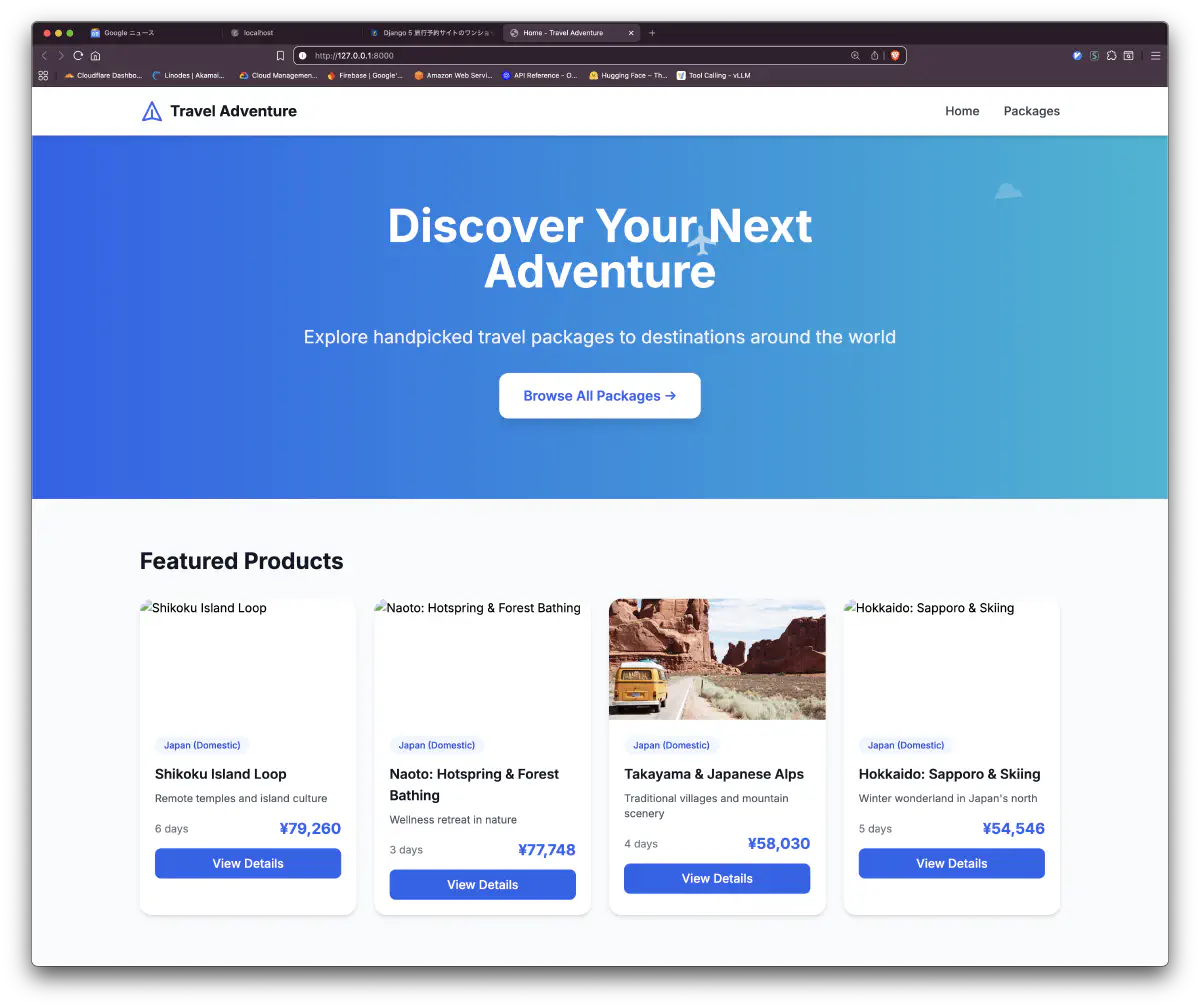
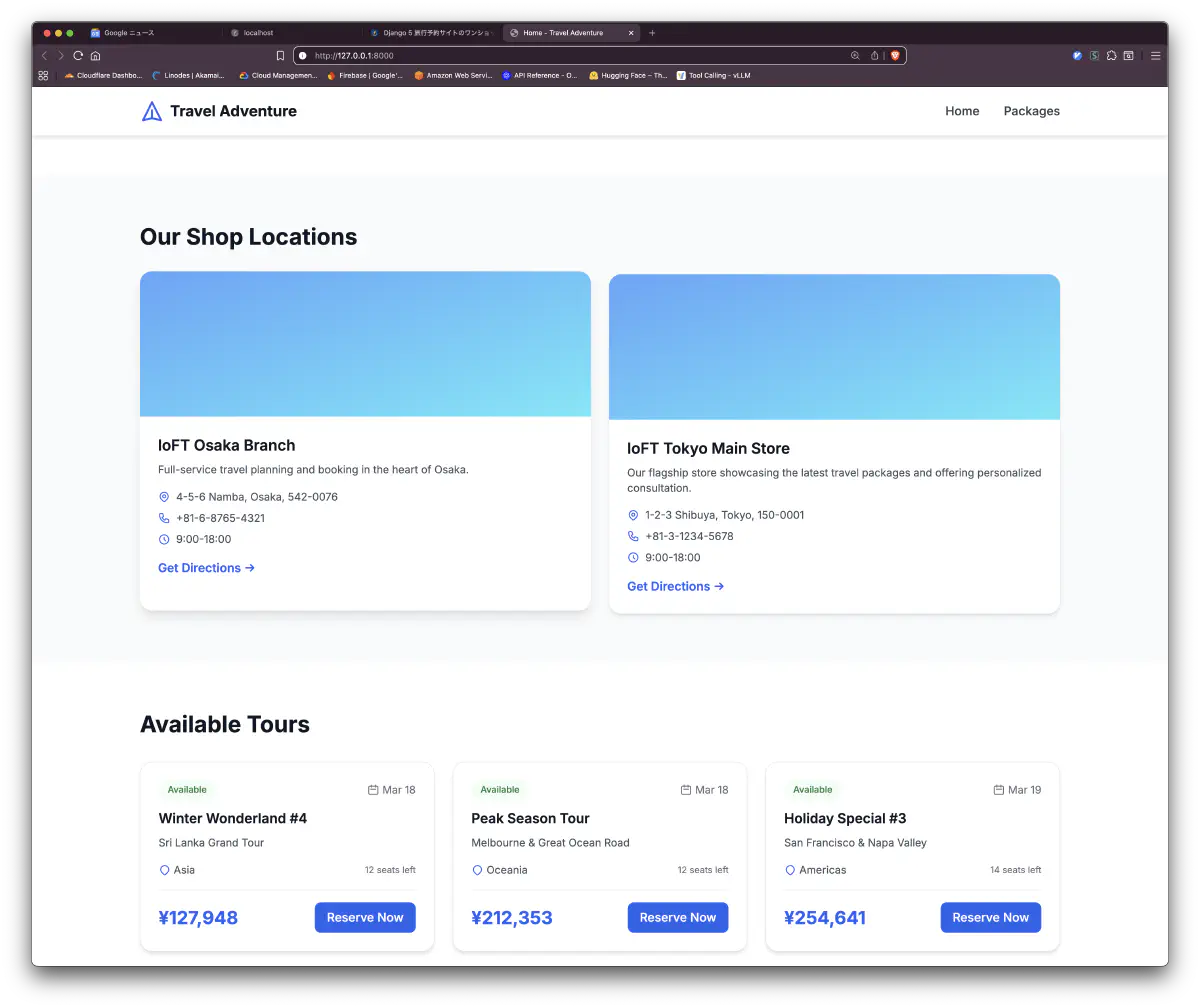
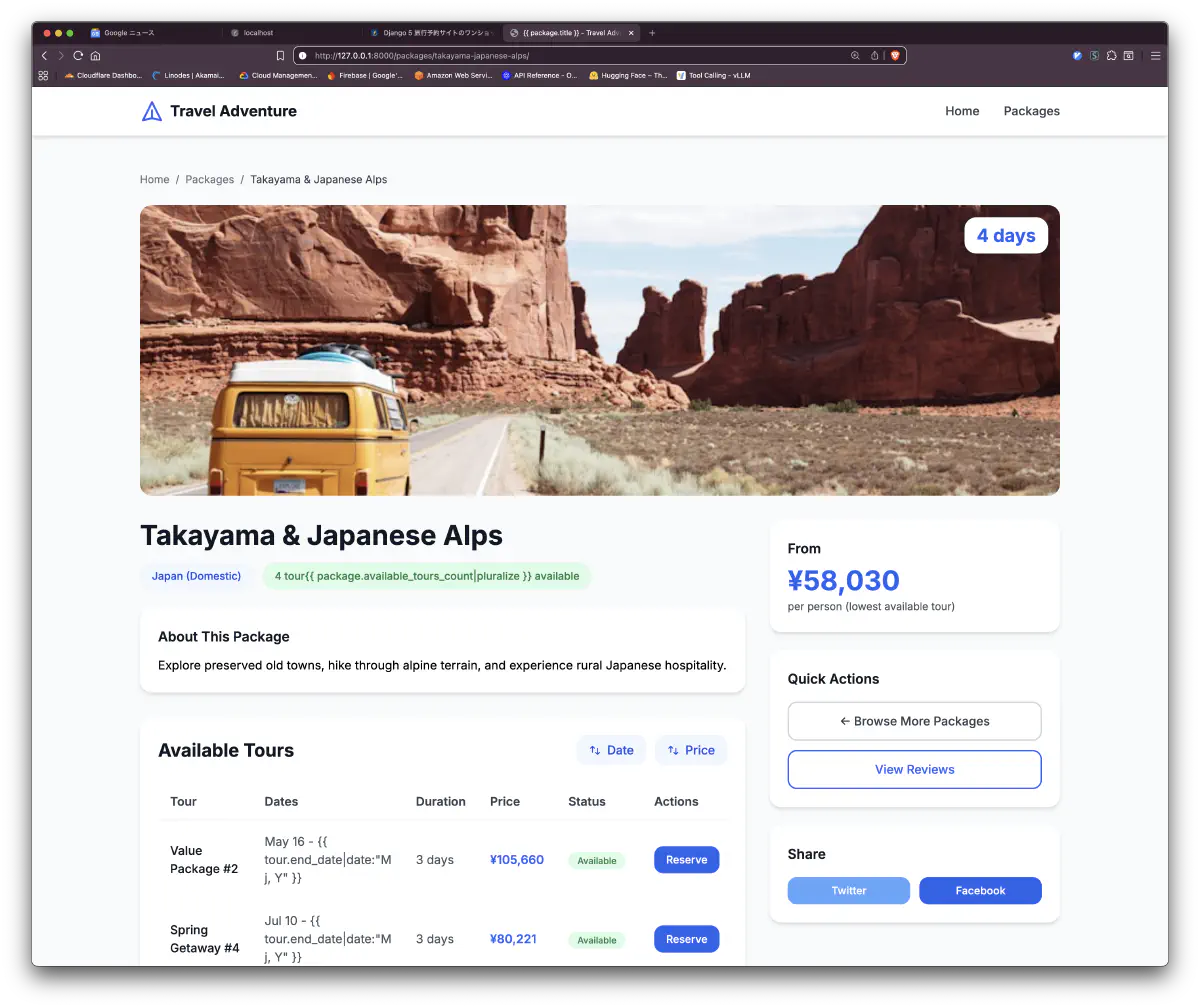
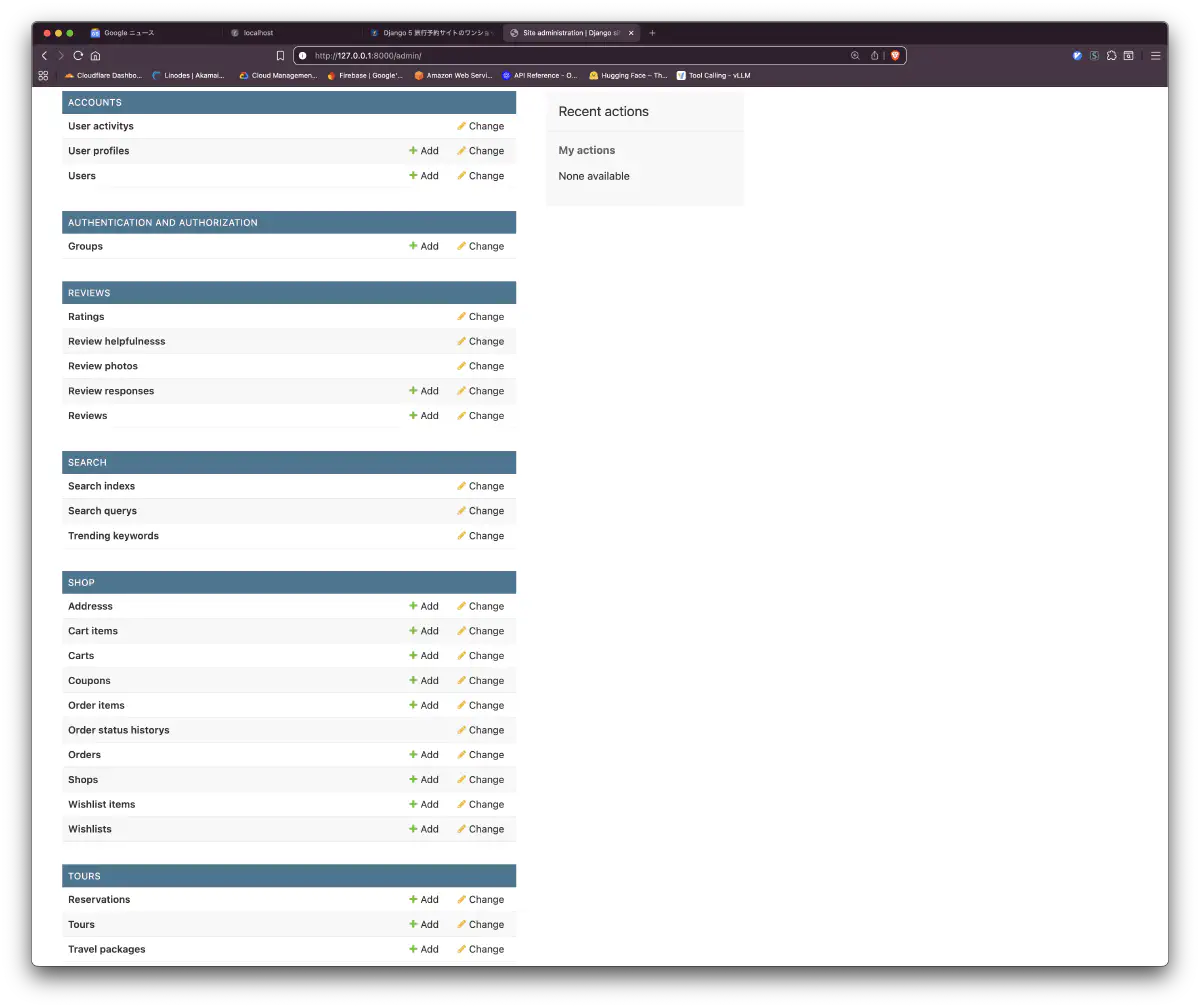
Initial Generated File Structure
| File | Content |
|---|---|
tours/models.py | 3 models + properties + validation |
tours/admin.py | Admin configuration for 3 models + inline |
tours/forms.py | ReservationForm (ModelForm) |
tours/views.py | 6 views (Home, List, Detail, Form, Confirm, Success) |
tours/urls.py | URL pattern definitions |
tours/management/commands/seed_demo.py | Seed data |
tours/templatetags/tour_filters.py | Custom filter (multiply) |
tours/templates/tours/*.html | 7 templates |
static/css/custom.css | SVG animations |
config/settings.py | INSTALLED_APPS additions |
Verification
After manual fixes, I confirmed:
- Server startup after migrations
- Frontend packages from seed data
- Alpine.js filtering and sorting
- The input → confirmation → completion reservation flow
- Admin inline editing
Key areas requiring manual fixes:
- Django template tag quote escaping on the package detail page (
{{ tour.end_date|date:"M j, Y" }}rendered as raw strings) - Some missing imports and type inconsistencies
- Cross-template consistency during feature expansion
SVG Animation
SVG and CSS created an eight-second airplane loop and a 15-second cloud loop.
What generation and fixes showed
1. Local MoE Model Coding Capability
Qwen3.5-122B-A10B (Q5_K_M) generated Django models, views, templates, and admin configuration and extended them with 77K tokens of context. Manual fixes remained necessary; cloud-equivalent quality was not established.
2. Specification Detail Determines Local LLM Accuracy
Useful specification details in this test:
- Field types, constraints, and defaults
- URL-to-view mapping
- ASCII UI wireframes
- Explicit Tailwind classes
Ambiguous specifications seemed to increase inconsistent output. I did not quantitatively compare this with cloud models.
3. Multi-MCP Server Coordination
ctree, pathfinder, serena, filesystem, and ripgrep supplied symbol analysis, path resolution, semantic operations, I/O, and search. The agent coordinated symbol lookup, file changes, and structure checks.
4. Template Escaping Issues
Quoted filter arguments such as {{ value|date:"M j, Y" }} had escaping errors. Cloud models can also make these errors; they were prominent manual fixes here.