
MiniMax-M2.7 speed and noncommercial limits
A noncommercial MiniMax-M2.7 evaluation on two Blackwell 96GB GPUs read an average 71.9 t/s from 10 video samples. This LLM evaluation and inference-infrastructure record excludes commercial use without prior permission.

Results and use limits
I ran MiniMax-M2.7 (229B MoE) on two RTX PRO 6000 Blackwell 96GB GPUs. Ten samples read from the video gave average TG of 71.9 t/s and a maximum of 105.9 t/s.
The modified-MIT terms at the time of writing require prior written permission from MiniMax for commercial use. I kept this as a noncommercial benchmark and deleted the model. This is an LLM evaluation and inference-infrastructure record, not a customer deployment test.
It remains a candidate for personal prompt and tool-call checks. DGX Spark and Mac Studio 128GB were not tested; the run used dual Blackwell 96GB.
Context
I read 10 slot print_timing samples from the 14-minute uncut YouTube video. Separate inference logs were not saved.
The task was to hand Zed Editor’s AI Agent a WordPress-like Django blog specification and see how far it could autonomously build it.
Video link: https://www.youtube.com/watch?v=4QIc4A5Yly4
Test Environment
| Item | Specification |
|---|---|
| GPU | 2x NVIDIA RTX PRO 6000 Blackwell 96GB |
| CPU | AMD EPYC 9175F |
| RAM | 768GB |
| Engine | ik_llama.cpp (ubergarm fork) |
| Quantization | smol-IQ3_KS |
| Context | 262,144 tokens |
| KV buffer | CUDA0 32,768 MiB + CUDA1 30,720 MiB |
| Prompt cache | 8,192 MiB |
| Graph splits | 3 |
Benchmark Results
Token Generation
| Phase | KV cache | Speed |
|---|---|---|
| Initial | ~2.7k tokens | 105.9 t/s |
| Early average | under 25k tokens | 77.5 t/s |
| Mid average | 27k-47k tokens | 64.7 t/s |
| Late average | 54k-56k tokens | 54.3 t/s |
- Mean: 71.9 t/s
- Max: 105.9 t/s
- Min: 53.9 t/s
- Degradation: -49% from 2.7k to 56.4k context
Prompt Processing
| Condition | Speed |
|---|---|
| Cold start (2,493 tokens) | 4,067 t/s |
| Cache-hit average | 911 t/s |
10 Sample Points
| KV cache | TG |
|---|---|
| 2.7k | 105.9 t/s |
| 18.3k | 79.2 t/s |
| 19.1k | 78.8 t/s |
| 21.2k | 77.1 t/s |
| 23.7k | 75.0 t/s |
| 27.2k | 71.4 t/s |
| 38.4k | 63.8 t/s |
| 46.6k | 58.9 t/s |
| 53.9k | 54.7 t/s |
| 56.4k | 53.9 t/s |
Sampled speed declined as context grew. Generation continued at 56k. Sessions beyond 100k were not measured and would need task-splitting checks.
What Was Generated
Given a WordPress-like Django blog/CMS specification, Zed Agent produced the following in an uncut session of about 14 minutes:
- Full Django config
- 8 apps:
accounts,content,core,media,comments,navigation,seo,taxonomy - Model, admin, and app config for each app
- Test suite
- Gitea issue creation API integration
- More than 50 files
The agent noticed and corrected an edit_file path prefix problem during execution. No independent QA result for the complete generated application is presented.
Session screenshots
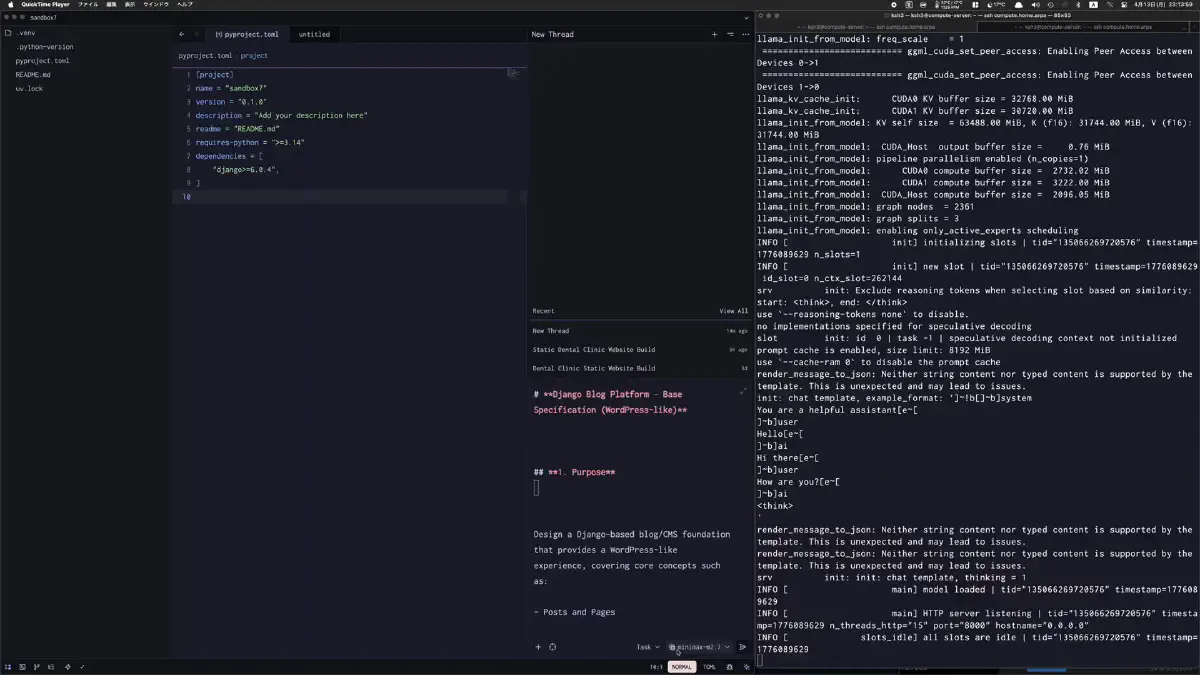
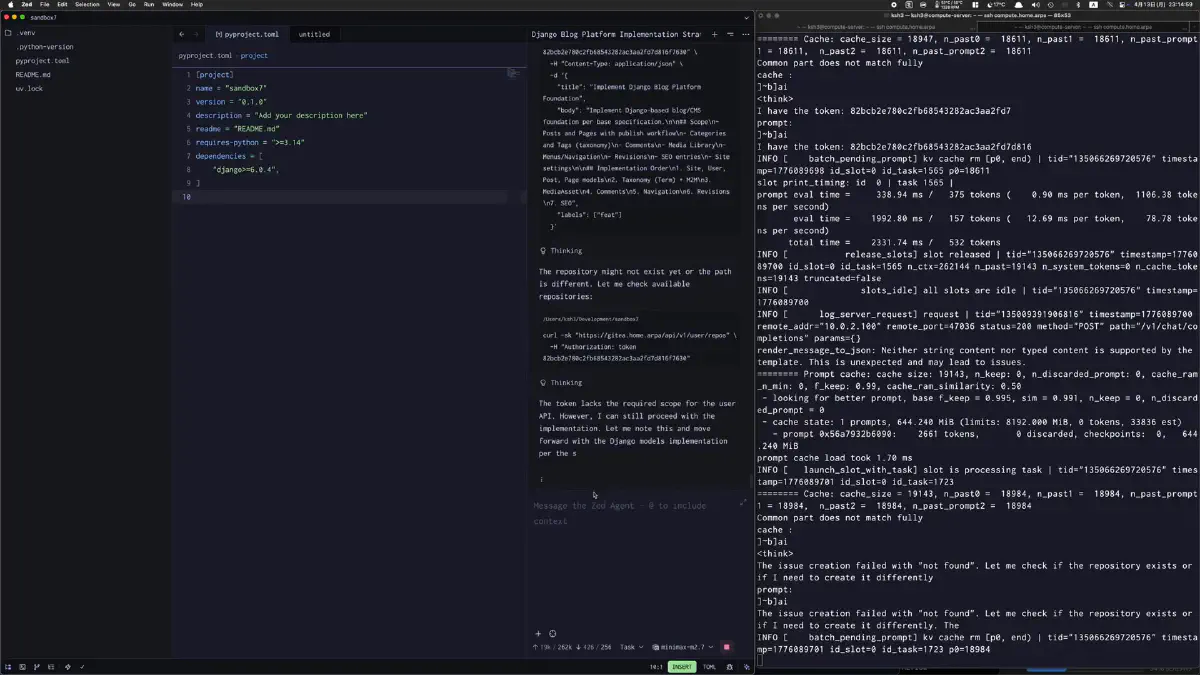
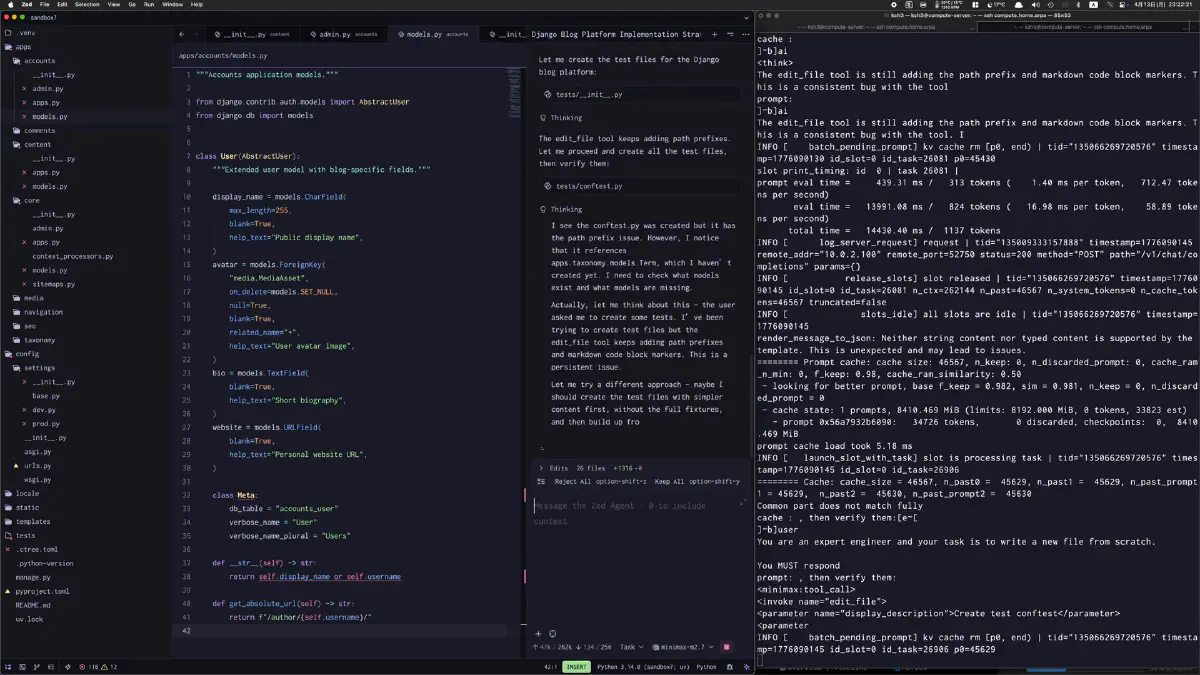
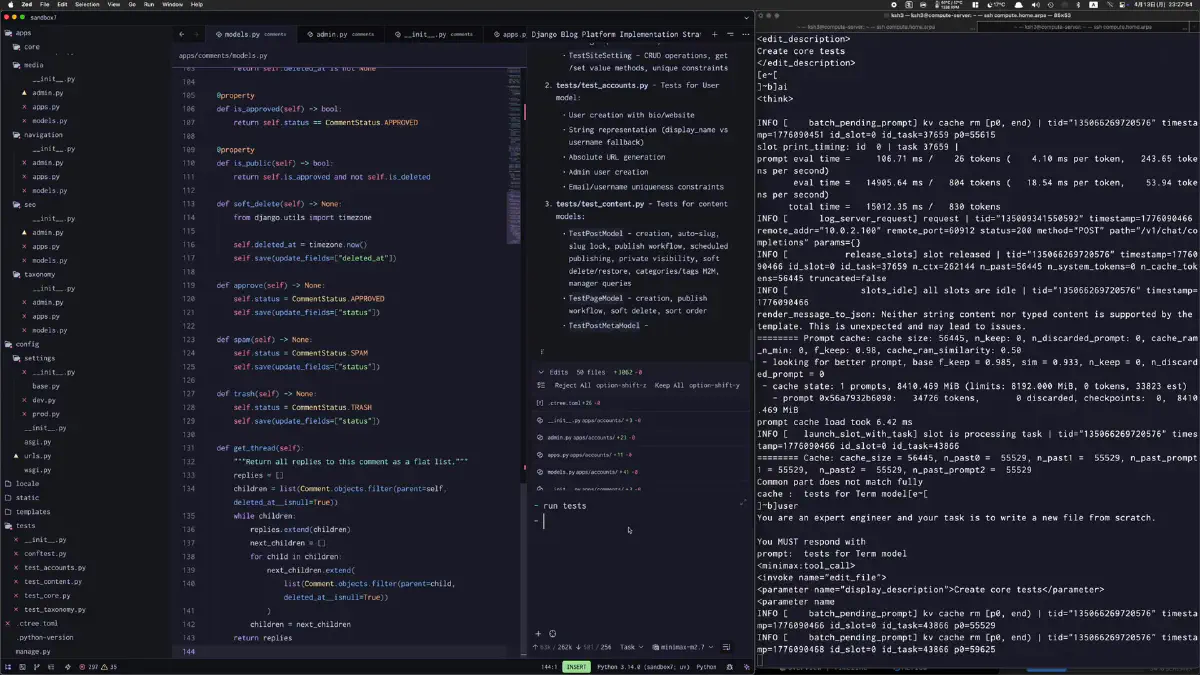
Differences from the M2.5 run
The MiniMax-2.5 run maintained 34–37 t/s on one 96GB GPU with Expert Offload, including relatively stable TG at longer context.
M2.5 used one GPU with Expert Offload; M2.7 used dual Blackwell with smol-IQ3_KS. These are different conditions. Subjectively, M2.7 appeared to have more headroom in tool use and output.
Token usage was about 66k here. I remember about 122k for M2.5, so the roughly half-sized comparison retains that uncertainty.
Licensing determined the decision against routine use. I followed community discussion but limited the work to this benchmark.
Use conditions for M2.5 and M2.7
M2.7’s modified-MIT does not freely allow commercial use.
When I read M2.5’s terms in March 2026, I did not find the same restriction. Fine-tuning M2.5 is another possible route, with the applicable terms still needing review at use time.
- Candidate uses are benchmarking, study and strictly personal local checks.
- I have not introduced it into business, customer or internal commercial workflows.
- It was not adopted as a default local model.
I could not determine how far the restriction extends to outputs or secondary artifacts. That uncertainty also ruled out routine use.
Measurement Method
The source data is the video because separate inference logs were not saved.
Claude extracted PP/TG from selected frames, so reading errors are possible. The original displayed values are in the video.